Elon Musk's Counterclaim Reveals the Reasons Twitter Obfuscates User Numbers as mDAU
The contrived mDAU metric allows Twitter to conceal the impact of its ideological purges of conservatives from the SEC, shareholders, and advertisers.
By Alexander Muse ·
If the public filings in Twitter’s lawsuit against Elon Musk make anything clear it is the fact that no one seems to have any idea how many people actually use the social network. In his complaint Musk reveals that Twitter’s executives realized early on that obfuscating user metrics could insulate the company from lawsuits and give them the freedom to interpret user numbers more favorably than their industry peers. Parag Agrawal seems to support this view insisting that it shouldn’t be Twitter’s burden to prove how many users it has given the complexity of the question and lack of data. At Twitter the obfuscation of user metrics is a feature, not a bug - ultimately the court will decide if Elon Musk has the right to know just how many users Twitter has BEFORE or AFTER he pays $44 billion for the company. If you’re like me you’ll want to read the latest filings from Twitter and Elon:
There was a time when Twitter used industry-standard metrics to describe its business to shareholders and advertisers. Just like Facebook, Twitter would detail user engagement by disclosing the number of monthly active users the platform had and how frequently those MAUs were interacting with content in a metric called ‘timeline views’. But at some point in 2014, in an effort to conceal disappointing user growth and declining engagement, the company stopped publicly reporting ‘timeline views’. User metrics got so bad that by 2015 the company even stopped reporting timeline views internally and eventually outlawed their measurement entirely. By May of 2015 executives began reporting inapplicable user metrics that the SEC and investors described as misleading at best and fraudulent at worst.1
By 2016 the company was actively fabricating user engagement by sending emails to the billion2 or so users that previously signed up for Twitter “informing them there was a problem with their username or account, which lead people to log in to fix the situation. Magically, those people become monthly active users even if they were not.”3 As a result of Twitter’s efforts to conceal the number of people who actually use Twitter from the SEC, investors, advertisers, and even themselves they were forced to pay one of the largest securities class action lawsuit settlements in U.S. history just six months before agreeing to sell the company to Elon Musk.4
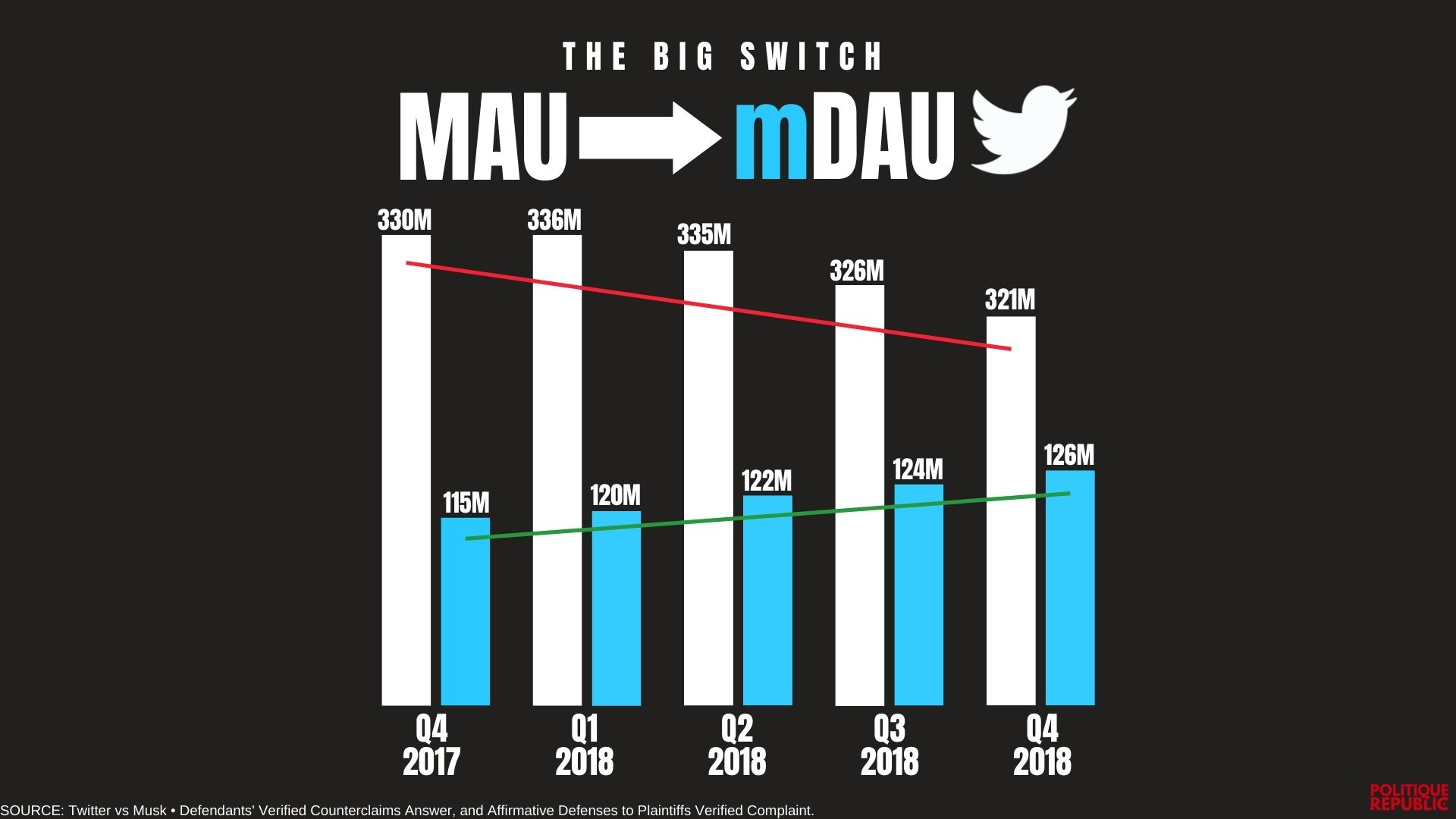
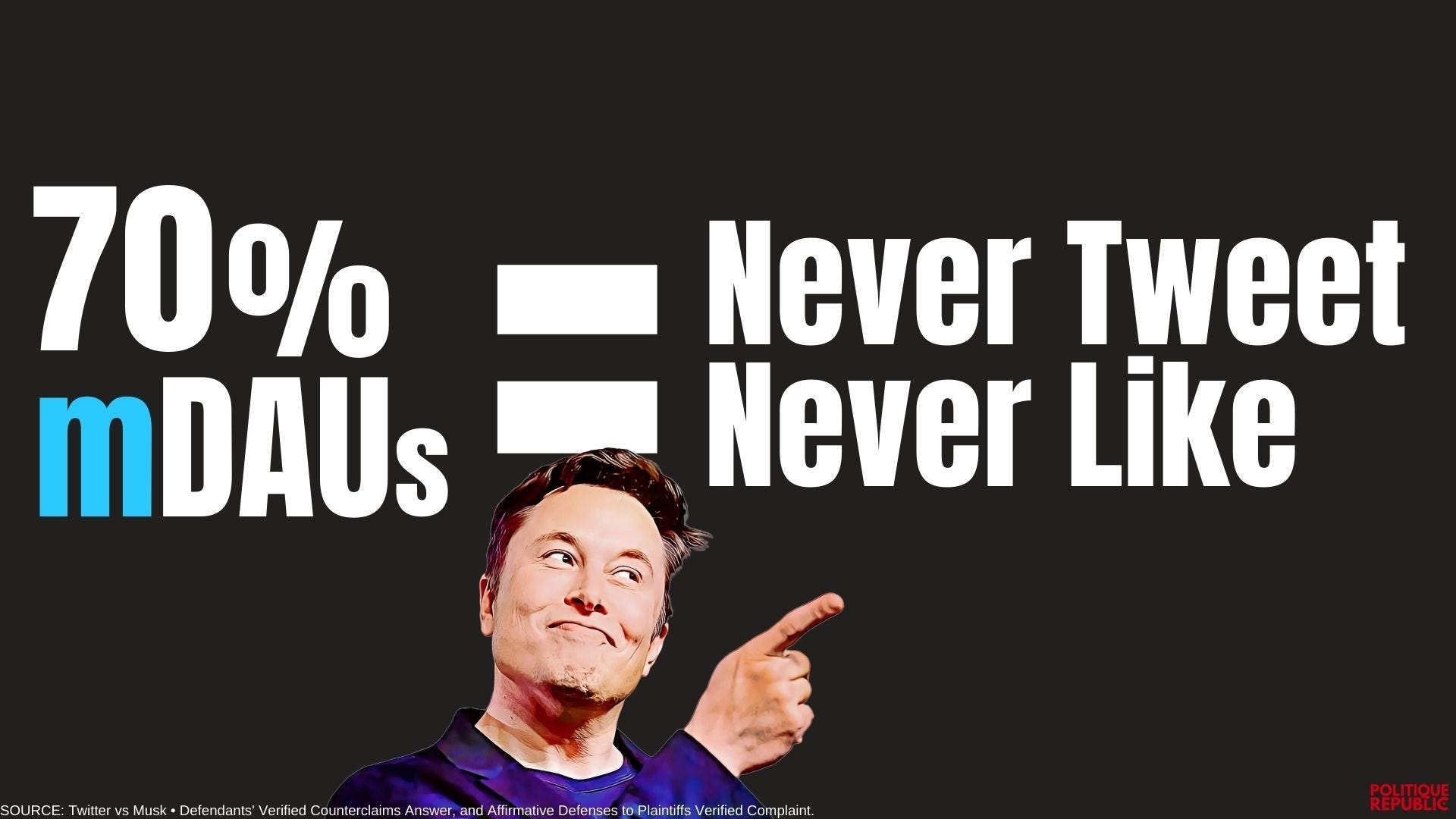
After multiple quarters of declining monthly active users, Twitter announced in its Q4 2018 Fiscal Year Letter to Shareholders that it would stop disclosing the industry standard MAU in favor of a new metric that it called mDAU. In its letter, Twitter admitted to shareholders that its new mDAU was not “comparable to current disclosures from other companies” and that its proprietary methodology was designed to numerically capture the “value” Twitter delivered to people who use the service.5 Twitter’s new user calculation, the mDAU, made it practically impossible for anyone, inside or outside of the company, to determine just how many people used Twitter on a regular basis. Using their new ‘secret’ mDAU metric Twitter showed that users and usage were not declining but actually growing.
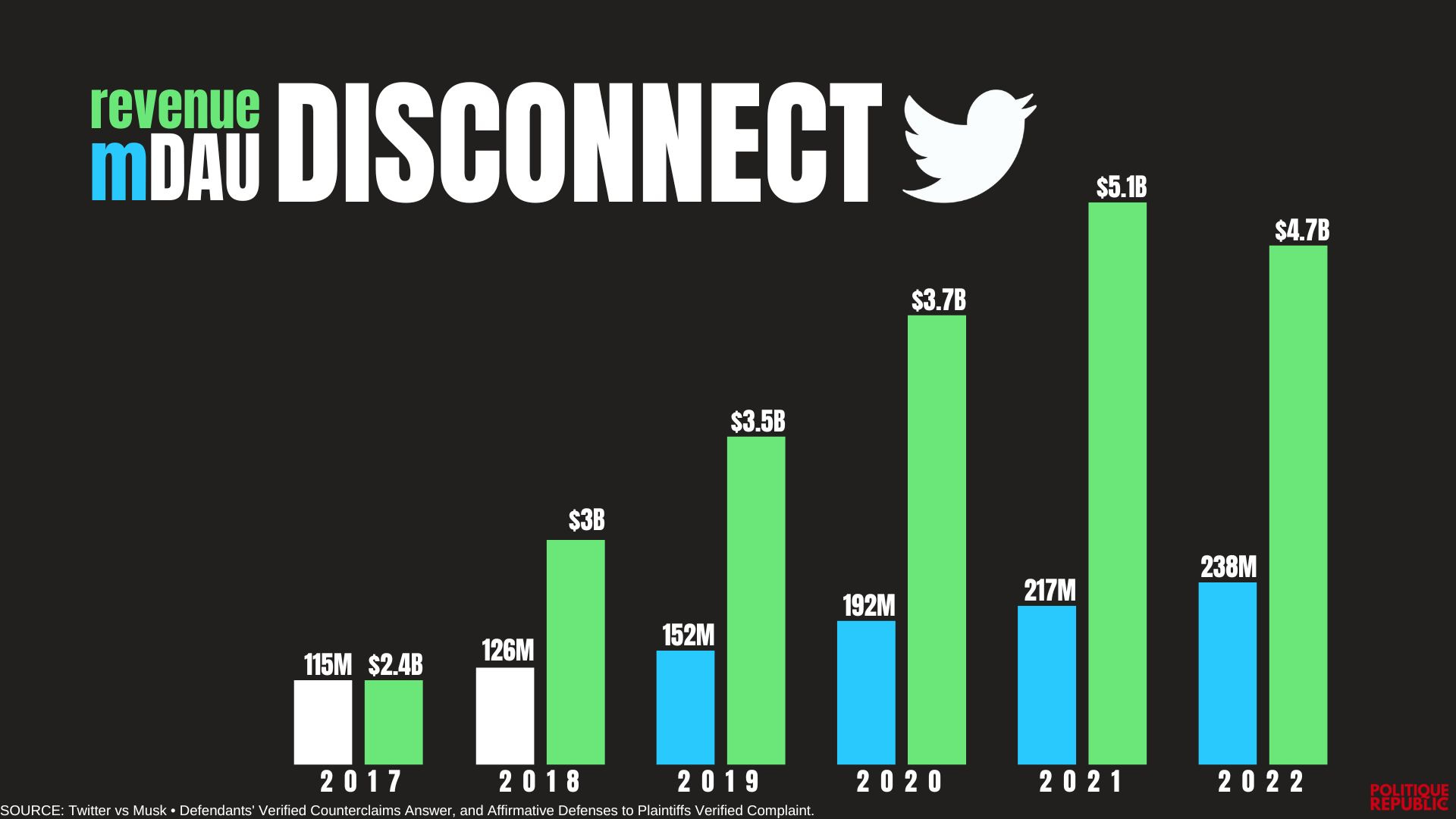
Prior to 2021 Twitter’s executives received cash bonuses based on meeting the company’s revenue, income, and EBITDA targets. You would think that if the growth of mDAU was closely linked to the company’s financial success AND mDAU were growing the company would be meeting its financial targets as well. In 2020, despite fantastic mDAU growth, Twitter’s executives missed their financial objectives and only qualified for 32% of their cash bonuses. To solve this disconnect Twitter tied executive bonuses to mDAU objectives in 2021 and shockingly everyone received 100% of their cash bonuses. In his complaint Elon Musk pointed this out explaining “since Twitter’s adoption of mDAU over MAU, it has reported ten straight quarters of ‘growth’ despite stagnant financial results.”6
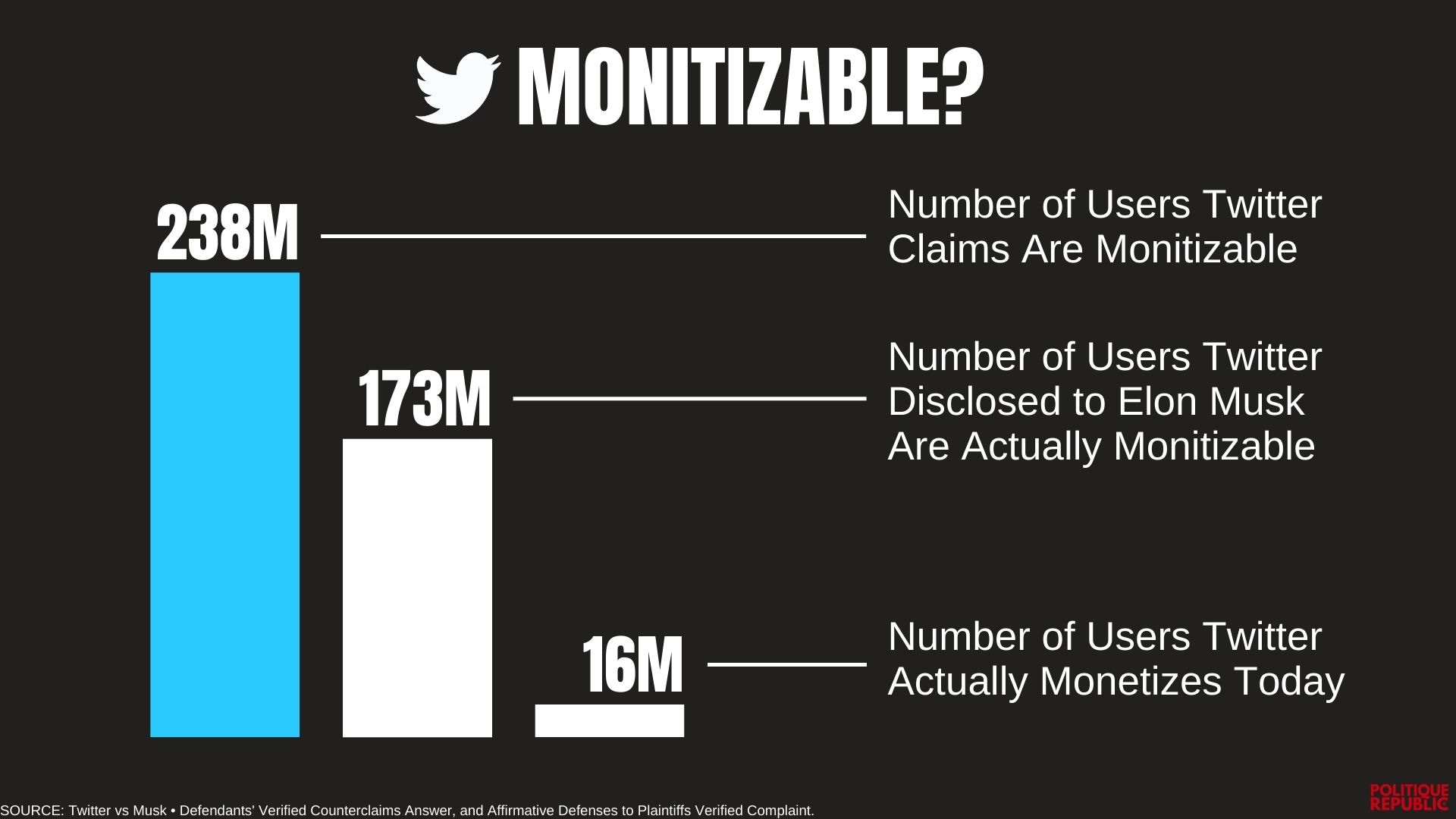
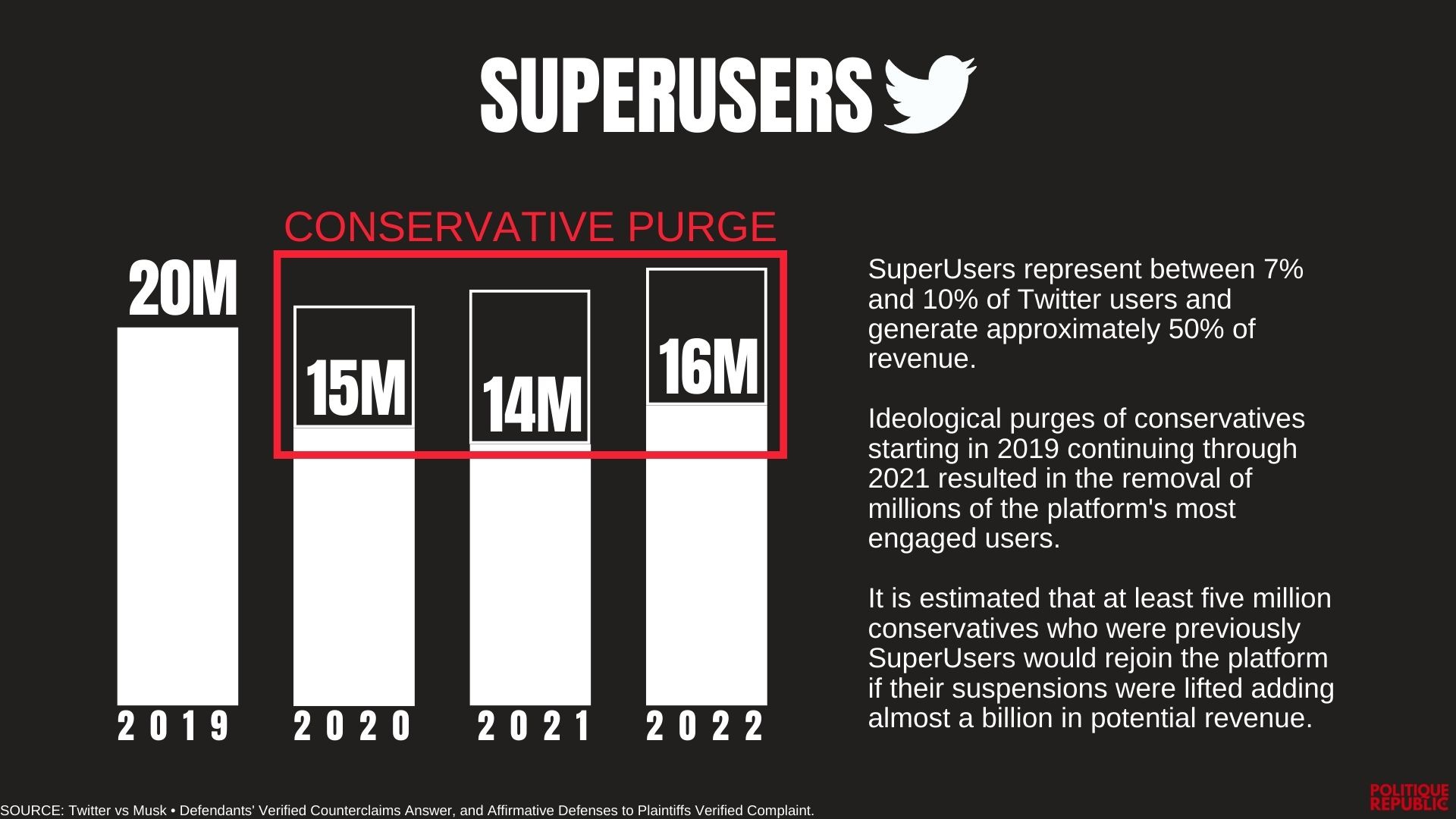
One of the most interesting things to come out of Elon Musk’s diligence process is the fact that highly engaged ‘SuperUsers’ represent fewer than 10% of all users but generate half of Twitter’s revenue. The typical SuperUser with fewer than 100,000 followers generates content that can reach as many as 20,000,000 people in a given day. The content these SuperUsers create breaks down into three main categories:
Politics (National, Local, International) - 44%
Entertainment (Hollywood, Sports, Music, Comedy) - 32%
Breaking News (Weather, Economy, Crime) - 13%
Twitter’s SuperUsers started getting a LOT of unwanted internal attention in 2019 when Democrats found their battle cry: President Trump is an Existential Threat to Democracy.7 Democrats publicly worried that conservatives had the upper hand on Twitter and media outlets like Politico just fanned the flames by publishing studies that purportedly showed that conservative “voices far outweigh liberals in driving conversations on hot topics leading up to the election.”8 Twitter employees, 99% of whom are Democrats according to the Federal Election Commission9, watched helplessly as President Trump used their platform to dominate the headlines each day. The company’s internal message boards were filled with a spasmodic mixture of anger, helplessness, resignation, and panic. One particularly popular message provided a point-by-point comparison of Trump’s rise to power with Adolf Hitler - the consensus was that given another term Trump would rule for life and democracy would end.
Twitter’s management team took their team’s concerns to heart and employees involved in ‘safety’ were given the green light to begin temporarily and/or permanently suspending SuperUsers that shared content that manipulated’ or ‘interfered’ with the presidential election - code for anyone who supported President Trump. Suspending these users was costly but Twitter’s team was filled with true believers.
Purges of conservatives came in waves and were justified in various ways. Thousands of users who shared articles that named the whistleblower that leaked the contents of President Trump’s call with Volodymyr Zelenskyy were permanently suspended. Thousands more were labeled QAnon and suspended for sharing conspiracy theories that Bill Clinton was a frequent guest of Jeffery Epstein’s island. More than a million conservatives who shared content from Hunter Biden’s laptop were suspended for sharing hacked information, personal information, or Russian disinformation (depending on which week it was).
The biggest purges came after the 2020 election as conservatives on Twitter began discussing election fraud - my own permanent suspension came after I shared an article about a Mississippi election where a judge found that 78% of mail-in-ballots were found to be fraudulent and a new election was ordered.10 Politifact eventually determined the story was true but Twitter never responded to my appeal - like millions of other conservatives caught in the purges my account remains suspended to this day. When Elon Musk announced he was buying Twitter millions of us hoped that he would restore our accounts and allow us to return to rejoin the conversation.
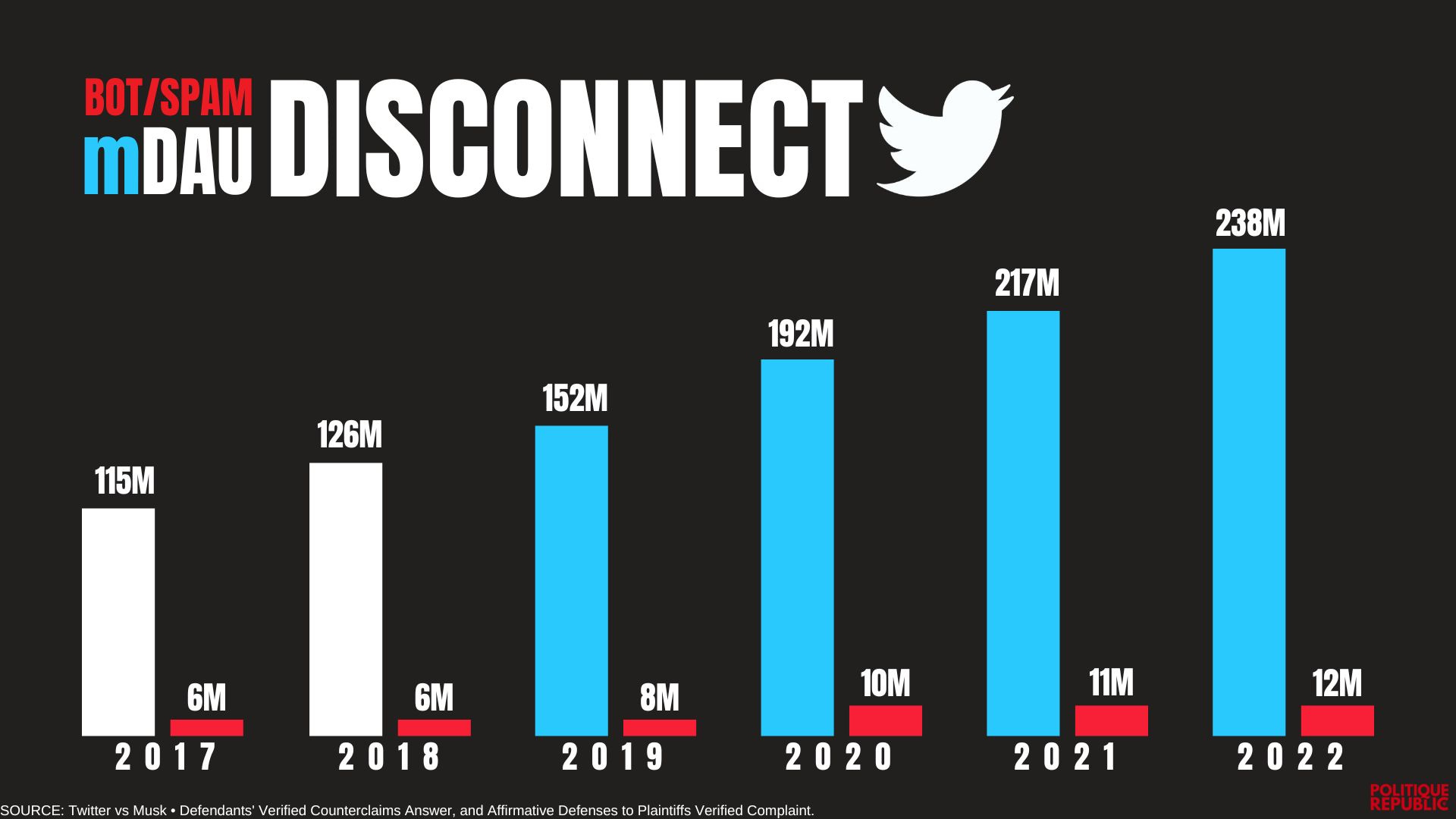
Last weekend Elon Musk made it clear that he would move forward with his acquisition of Twitter if Parag Agrawal would disclose the company’s methodology for confirming that 95% of their users are real. He even challenged Parag to a public debate about Twitter’s bot percentage.
The fact of the matter is that there is ZERO chance that Parag Agrawal would agree to a debate because it is clear he has no idea how many users Twitter has. The public filings make it clear that Twitter has purposefully designed its metrics to obfuscate the number of real humans who use its platform. Of course, if Twitter’s former employees are to be believed (and Twitter just paid one of the largest securities fraud settlements in US history based on their testimony) Twitter can’t be trusted to tell the truth about its user numbers. At the end of the day, a judge in Delaware will decide whether or not Elon Musk has the right to know how many real people actually use Twitter before he buys the company… Selfishly, I hope she makes him buy it…
If you’re interested in the sort of testimony Twitter will face from their own employees just read through these eleven witness statements from the company’s recently settled fraud case:
Confidential Witness No. 1 ("CW-1") was employed by Twitter from 2011 through late 2015 in its San Francisco headquarters as a senior manager of the Growth and Engineering teams. During CW-1' s four years at Twitter, CW-1 spearheaded several user growth initiatives and was involved with projects that were designed to drive MAU growth. According to CW-1, there was a distinct difference in engagement and churn among prior inactive users who Twitter prompted to return to the site as opposed to new users who signed up "on their own." Returning prior inactive users were far more likely to drop back off (churn) within a short period of time because they already had done so in the past. CW-1 noted that the MAU growth achieved during 2014 mostly involved "bringing back low-quality MAU" and that low-quality MAUs were less likely to become DAUs. When Noto provided investors MAU growth projections of 550 million users at the November 2014 Analyst Day conference, CW-1 said that he was unaware of the basis for these projections and would not have provided a number as high as 550 million users because MAU growth over the prior six to 12 months would not be repeatable. This was because at least some of that MAU growth was driven by actions Twitter took to re-engage old users — or low-quality growth. CW-1 said that DAUs were a "much better proxy for engagement" than the Timeline Views metric, which Twitter stopped reporting in November 2014, and that it was a "mistake to not disclose DAU" after Twitter stopped reporting Timeline Views. CW-1 reported that DAU was the primary engagement metric that Twitter tracked internally after Timeline Views were no longer being reported. During 2014 and early 2015, CW-1 's team "talked about DAUs constantly," including ways to drive DAU growth. According to CW-1, the Company was concerned over the lack of DAU growth and was "pushing pretty hard" to increase DAUs. Along with the engineering leads, CW-1 attended the Product Leadership meeting every Tuesday. This meeting typically lasted one to two hours, and the attendees discussed DAU growth. CW-1 explained that user engagement was directly related to MAU growth: "[U]ser engagement is a key driver of MAU growth." CW-1 observed that the DAU trajectory was generally flat during early 2015; without DAU growth, Twitter could not achieve meaningful MAU. According to CW-1, stagnant DAU growth would eventually cause MAU growth to stall, and that is generally what occurred at Twitter during the first half of 2015. According to CW-1, this lack of growth led to Costolo's ouster. While Twitter told the public that Costolo was voluntarily leaving Twitter to move on to new things, it was "internally thought" that Costolo was asked to leave because "growth was not happening" as planned.
Confidential Witness No. 2 ("CW-2") was employed by Twitter from the summer of 2014 through the summer of 2015 as an engineer in the advertising "ecosystem" and part of the business development department. CW-2 was responsible for managing partnership integration of third-party data into the Twitter dashboard. CW-2 was knowledgeable about MAUs because of how important this metric was to Twitter. CW-2 said that the growth of MAU was "paramount to Twitter's success." CW-2 explained that everyone at the Company with whom he spoke understood the growth was flat during CW-2' s year-long tenure at Twitter. CW-2 regularly attended Tea Time meetings while he worked at Twitter. During the Tea Time meetings, Twitter's senior management presented MAU and MAU projections. In late January or early February 2015, Twitter's senior management abruptly stopped presenting MAU and MAU projections at these meetings. CW-2 said that DAUs were calculated daily to monitor user engagement and that this metric was talked about on a daily basis by Twitter employees. DAUs were tracked internally throughout CW-2' s employment. CW-2 explained that there was concern in CW-2' s department over the trajectory of DAUs during late 2014 and early 2015. According to CW-2, user engagement was important because the "lack of eyes" on the Twitter platform meant a "lack of ad dollars." CW-2 said that the people with whom he spoke at Twitter understood that Costolo was pushed out of the Company due to a lack of user growth.
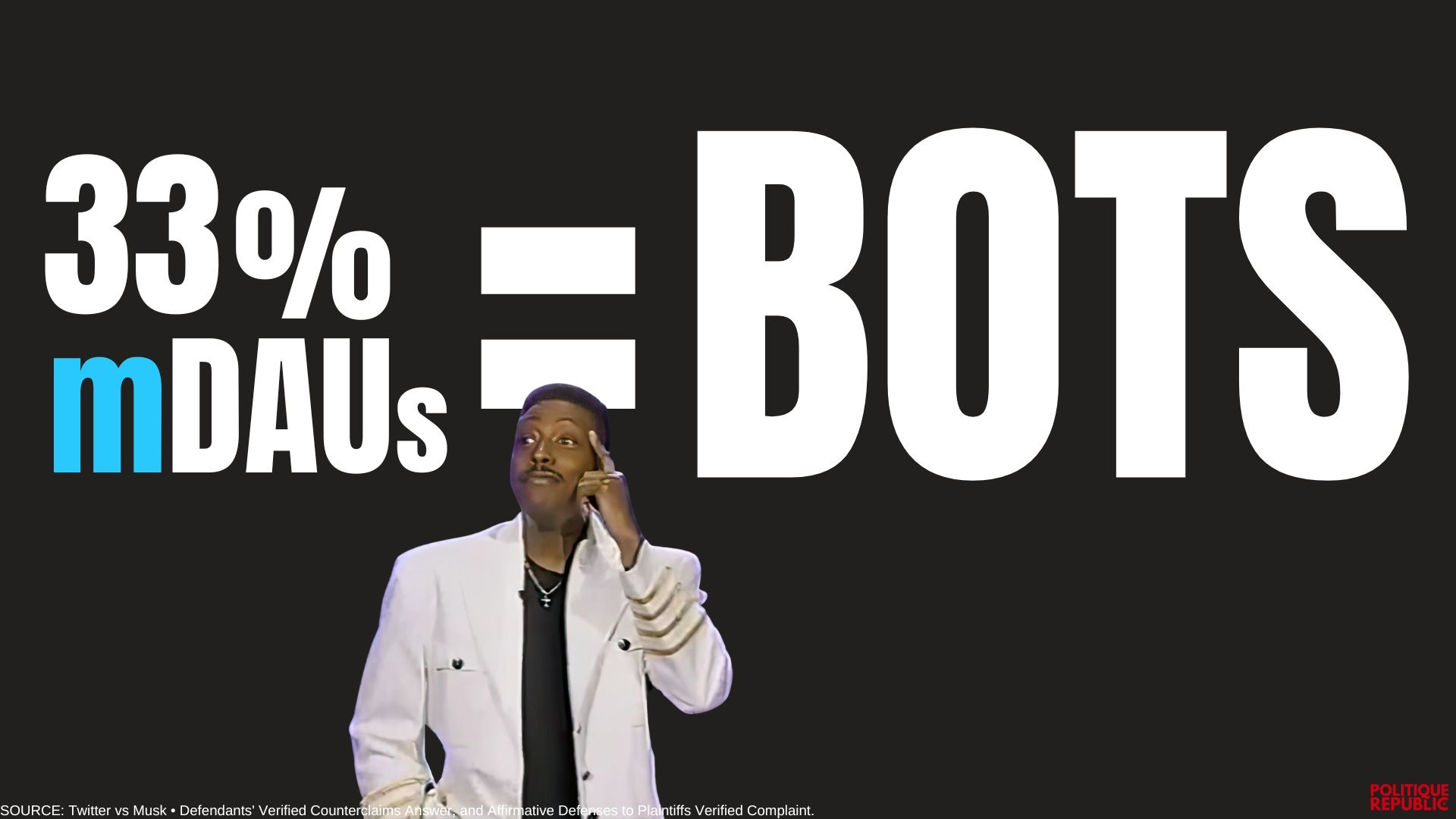
Confidential Witness No. 3 ("CW-3") was senior manager of marketing at Twitter from 2013 to early 2015. CW-3 was aware of the MAU numbers and kept track of this metric through Company earnings reports. According to CW-3, MAU was "not a good metric" in isolation because the MAU metric could be easily manipulated to make the growth or user base appear inflated. For example, CW-3 believed that "zombie users" and robot users contributed to Twitter's overall MAU metric. "Zombie users" are users who signed onto Twitter once a month because they were prompted to sign in through an email or other services that require a Twitter login. These "zombie users" were not actively engaged in Twitter. Likewise, fraudulent users who utilized robot accounts were also an issue at Twitter. These robot accounts could easily have been created or bought, and CW-3 noted that some companies in the tech industry bought robot accounts in order to inflate their MAU numbers.
Confidential Witness No. 4 ("CW-4") was employed by Twitter as a staff technical program manager from spring 2014 to fall 2014 and built source code management tools for engineers. CW-4 was aware of the MAU and DAU metrics because they were very important to Twitter. CW-4 attended bi-weekly companywide meetings known as "Tea Time." At these meetings, company executives discussed MAU and DAU metrics and metric trends to the entire Company. At Tea Time meetings CW-4 attended, Twitter executives reported that MAU and DAU trends were flattening out. According to CW-4, MAU and DAU metrics are fairly correlated.
Confidential Witness No. 5 ("CW-5") was employed by Twitter from 2013 to the end of 2015. Initially, he worked as a data center engineer and then was promoted in early 2015 to a senior position overseeing data center engineering. CW-5 was responsible for the improvement of Twitter’s data center engineering, including the increase in data center capacity in order to accommodate Twitter’s user growth. As part of CW-5’s responsibilities, CW-5 was privy to metrics that indicated how much the user base was growing in order to see how much capacity needed to be added to the data center. CW-5 noted that, although the Company looked at numerous metrics, the most important metrics to Twitter were MAU and DAU, which were monitored closely by Twitter’s management. CW-5 did not know why the projected user growth was always so high, since the results were always disappointing. CW-5 attended “capacity meetings” every two weeks during CW-5’s employment at Twitter. These capacity meetings were attended by engineering leadership, including the Vice President of Engineering and other senior engineering employees. During these meetings, metrics such as MAU and DAU were heavily discussed and analyzed. CW-5 “absolutely” saw metrics that showed user base was flat or declining leading up to and continuing through the Class Period. CW-5 recalled “big discussion” during these meetings regarding why the engineering team was continuing to build server capacity to accommodate additional users when there was no real user growth. CW-5 also observed that DAU trends were declining during the Class Period. As a result, Twitter management was scrambling to come up with other metrics that would impress investors and “turn Wall Street’s view” away from the flat or decreasing DAU and MAU.
Confidential Witness No. 6 ("CW-6") was employed as a contract employee for Twitter from the end of 2014 until the fall of 2015. In that role, CW-6 worked as a language lead in the Trust and Safety Department. CW-6 — who has a background in quantitative data research — was tasked with identifying patterns of abuse in different regions where Twitter was active. CW-6 managed complaints from users regarding issues like harassment, impersonations, copyright infringement and privacy rights. CW-6 also monitored MAU and DAU on a regional scale, as part of CW-6' s duties was to compare MAU and DAU trends in different regions around the world. CW-6 also authored reports regarding DAU on a weekly and monthly basis. CW-6 said that the Company "absolutely" should have disclosed to the public earlier that MAU growth was flat and said that, internally, Twitter management knew that the MAU growth was weak and could not match its predictions. During the Class Period, CW-6 had numerous private conversations with several "department heads" who were well respected within the Company regarding concerns over MAU growth, and these managers similarly did not believe that user growth was sustainable. In addition, CW-6 said that the fake accounts contributed greatly to the number of "new" users and active users. These numbers were misleading because they reflected users who were not authentic users, and it falsely inflated Twitter's overall metrics. According to CW-6, the MAU and DAU trends that were reported by Twitter during CW-6' s employment were "not realistic." CW-6 observed regions that had an unrealistically high number of Twitter accounts where the internet infrastructure was poor, and was not set up to support that many Twitter users. CW-6 also observed regions where there were more Twitter accounts than there were potential Twitter users in the area. CW-6 identified numerous users that used automated programs (or "bot programs") to spam other Twitter users thousands of times. According to CW-6, Twitter management knew the fake accounts were an ongoing problem and chose to ignore it because it contributed to the Company's overall user metrics. In early spring 2015, CW-6 created a "business case" in Excel that logged how many duplicate accounts Twitter users had, how many automated robot programs there were, and analyzed Twitter users' complaints of fake accounts. CW-6 also ran internal tests that examined how these fake accounts contributed to Twitter's overall metrics. When CW-6 reported the issue of the fake accounts and presented the business case to CW-6's manager, he was told to "do your job and be quiet." According to CW-6, DAU metrics were significant to Twitter and were discussed every week during manager meetings in CW-6's department, where CW-6 and other managers evaluated staffing needs. Twitter closely monitored its DAU numbers in order to manage its staffing and hiring needs.
Confidential Witness No. 7 ("CW-7") was employed by Twitter from early 2014 to early 2015 as product manager in the Company's Advertising Department. In that role, CW-7 was responsible for developing advertising formats, as well as "promoted trends" and "promoted accounts." Promoted trends are tweets or relevant information promoted by Twitter's advertising partners, and promoted accounts are suggested accounts for Twitter users to follow. While at Twitter, CW-7 was aware of the MAU trends, noting that from early 2014 to early 2015, the Company's MAU growth was only around 5% month-to-month and mostly flat. In addition to MAU, CW-7 observed that by late 2014, DAU growth was also mostly flat. CW-7 worked on the advertisement side, where there was a direct relationship between the number of ads displayed and DAU. CW-7 explained that Twitter's advertisement system did not display an ad for every viewer, and instead it used an algorithm to calculate how many advertisements to send to a user. When a user launched the Twitter app, it made a request to Twitter's back-end server to request a timeline, and each of these timeline requests also sent a request to Twitter's ad server, which filled the timeline with a certain number of ads. Accordingly, there was a direct correlation between daily usage and the number of advertisements sent to a user. Twitter used "Ad Load" to determine how many advertisements to send to a user. Early in CW-7' s tenure, the directive at Twitter was that each user should not see more than roughly 2.5 advertisements in a certain time frame. In late 2014, Twitter's management changed the directive and increased the number of advertisements a user could see in the same time frame. CW-7 explained that because there was flat user engagement growth and no increase in DAU metrics, the total number of advertisements that Twitter sent also remained stagnant. Therefore, in order to improve the advertisement metrics and the number of advertisements sent to users, the "Ad Load" had to be increased to compensate for the lack of user (MAU) growth and user engagement (DAU) growth. According to CW-7, MAU and user engagement trends were flat around late 2014, and the growth team had difficulty getting the metrics to go up. Various growth projects at the time were also stalled or deprioritized.
Confidential Witness No. 8 (CW-8) was employed by Twitter as a manager in its data center from 2011 until early 2015. In that role, CW-8 participated in some regular operations and capacity planning meetings. CW-8 was aware of Twitter's growth problems from the various capacity planning meetings CW-8 attended. According to CW-8, Twitter employees from the systems team would project what server capacity would be needed over the next month or quarter. Server capacity was calculated by adding up expected growth and expected attrition. Growth was a positive number that represented the number of users that would join Twitter, and attrition was a negative number that represented the expected number of users that would leave Twitter. CW-8 said that growth included organic growth and "paid growth." "Paid growth" users were not users that Twitter paid to use its service, but rather additional users gained through efforts by Twitter's marketing team. CW-8 said that paid growth users that signed up as a result of Twitter's marketing campaigns were not engaged and did not remain Twitter users. CW-8 said that towards the end of CW-8' s tenure in early 2015, growth was "really dying down."
Confidential Witness No. 9 ("CW-9") worked at Twitter from 2013 until late 2014 as a senior manager of Twitter's mobile-ad business. CW-9 said there had been an "internal dashboard" at Twitter by which "anybody could pull up" engagement metrics. Furthermore, selling to advertisers, which was what CW-9 had been doing while at Twitter, involved touting user numbers so such data was "broadly available" within the Company. CW-9 said that "MAU says nothing about frequency" of use and therefore does not provide "sufficient detail to measure an advertising opportunity."
Confidential Witness No. 10 ("CW-10") worked at Twitter as a senior manager in the Engineering Department from 2010 to the spring of 2015. In that role, CW-10 built the main infrastructure for serving tweets, timelines, users and the social graph to developers inside and outside of Twitter. According to CW-10, "MAU was a terrible metric" and there is no way you could "judge the health of the company using MAU alone." MAU was also flawed because it required a significant delay for an update: "You had to wait a month to get an updated metric." Because of this delay, the metric was not current enough to "use in making strategic decisions." CW-10 described a "metric dashboard" that was available to Company employees. This internal dashboard included the DAU metric as well as other metrics.
Confidential Witness No. 11 ("CW-11") was employed by Twitter as a senior manager on the Global Ads Yield Management team from spring 2014 until the end of 2015. In that role, CW-11 was responsible for developing an advertising market place in order to ensure that both short-term and long-term revenue goals could be achieved. As part of CW-11' s advertising-related work, CW-11 determined the number of Twitter advertisers and levels of customer engagement. As CW-11 got "deeper" into these metrics, by the end of 2014 it was apparent that Twitter's user engagement rates were "not great." According to CW-11, these metrics "were readily available [to other Twitter employees] and calculable." CW-11 said that any way one looked at the engagement of users, it was "inescapable" in late 2014 and early 2015 that there was "a lack of engagement" by users with the platform. CW-11 explained that the metrics presented "a very bleak picture of user engagement." CW-11 noted that there is no direct correlation between advertising engagement, on the one hand, and MAU or DAU, on the other. Instead, advertising engagement measures the effectiveness of ads and the frequency with which customers are using ads.
Oh, and I thought this video from a few of Elon’s friends getting subpoenaed by Twitter was funny:
THE FILINGS
https://www.twittersecuritieslitigation.com/Content/Documents/Complaint.pdf
https://lowercasecapital.com/2015/06/03/what-twitter-can-be-2/
https://archive.vanityfair.com/article/share/49676336-9f8a-40af-8cfa-b71bc9b33491?itm_content=footer-recirc
https://time.com/6099976/twitter-class-action-lawsuit/
https://static.poder360.com.br/2019/02/Q4-2018-Earnings-Press-Release.pdf
https://www.documentcloud.org/documents/22127591-musk-public-version-of-counterclaims-answer-w-cos?responsive=0&title=1&onlyshoworg=1
https://www.theatlantic.com/politics/archive/2019/07/democrats-have-found-their-battle-cry/593881/
https://www.politico.com/news/2020/10/26/censorship-conservatives-social-media-432643
https://nypost.com/2021/12/04/data-shows-twitter-employees-donate-more-to-democrats-by-wide-margin/
https://www.politifact.com/factchecks/2021/mar/05/facebook-posts/judge-did-order-new-election-small-miss-city-after/

