Congress codified the legal doctrine of fair use to promote free expression and ensure a free and prosperous democracy. It is time for Congress to update the Copyright Act of 1976 to include Big Tech.
Two hundred years after the founding of our great experiment, Senator John McClellan introduced the Copyright Act of 19761 codifying a legal doctrine known as fair use. McClellan, who at 17 years old was the youngest attorney in the United States2, believed that the concept of fair use was vital to ensure both a free and prosperous democracy. To that end, Section 107 of the Act sought to protect free expression by allowing the unlicensed use of copyright-protected works for criticism, comment, news reporting, parody, teaching, scholarship, and research.
For almost 50 years the fair use doctrine has protected Americans from censorship and suppression. Copyright holders who sought to block the fair use of their works were more often than not rebuffed by the courts when the use was, indeed, fair.3 Perhaps more important were the millions of instances of fair use that were never challenged in court. Fair use was not only celebrated for promoting free expression but for its massive contribution to our nation’s wealth.
In fact, Ed Black, the president of the CCIA a trade association representing big tech companies like Amazon, Google, YouTube, Microsoft, and Redbubble stated4,
"As the United States economy becomes increasingly knowledge-based, the concept of fair use can no longer be discussed and legislated in the abstract. It is the very foundation of the digital age and a cornerstone of our economy. Much of the unprecedented economic growth of the past ten years can actually be credited to the doctrine of fair use, as the Internet itself depends on the ability to use content in a limited and unlicensed manner.”
The CCIA released a study that relied on a methodology developed by the World Intellectual Property Organization finding that:
Fair use is responsible for 18% of US economic growth
Fair use-dependent industries employ 11 million US jobs
Fair use generated more than $4.5 trillion in annual revenue for the Treasury
Fair use-dependent industries represent one-sixth of total GDP
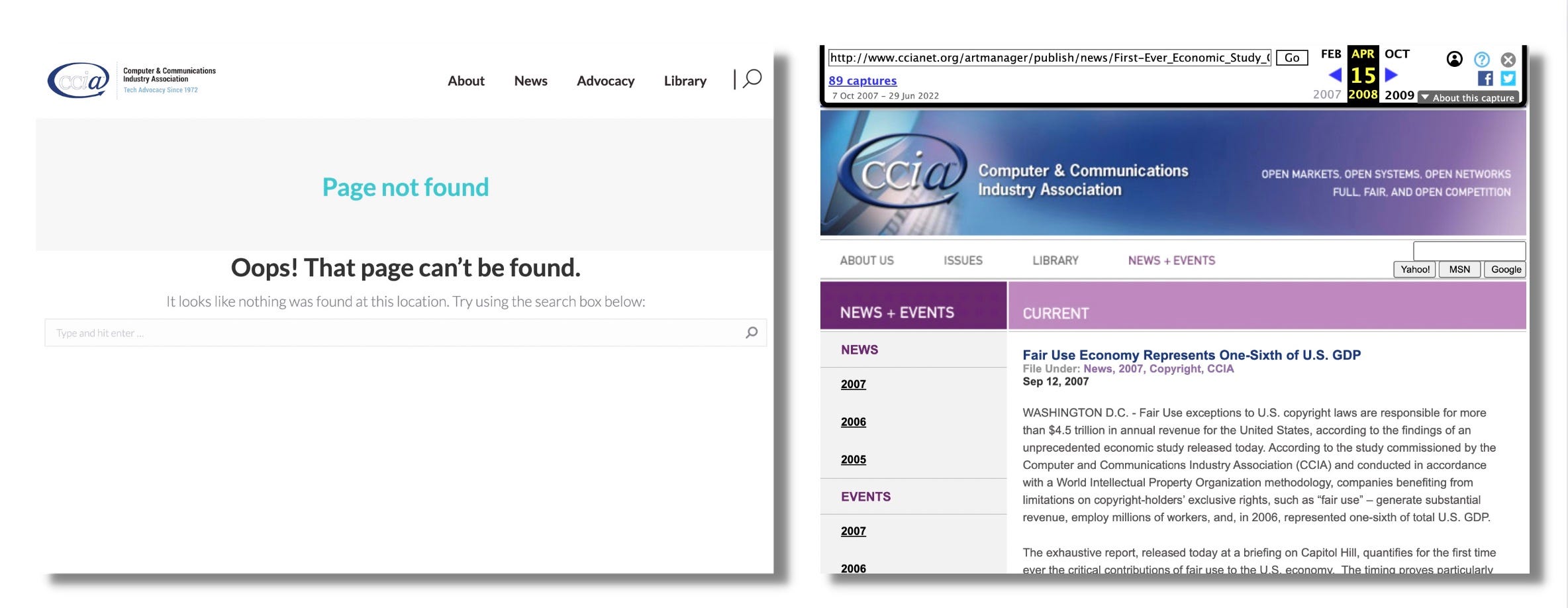
Fast forward five years and the study paid for by Amazon and Google has been scrubbed from the CCIA’s website (you can read it HERE on the Internet Archive).
Copyright holders quickly realized that if big tech platforms like Twitter, Amazon, and YouTube could limit free speech because they were private companies they could also limit fair use. Since then copyright holders and big tech have worked together to build systems that make it very easy for copyright holders to request that big tech platforms censor a particular work. For example, on Amazon copyright holders get a preview of every book sold on the platform BEFORE it is available for sale. If the copyright holder claims the book contains copyrighted material it is blocked for sale - this is true even if the use is clearly fair use. To add insult to injury the author who wrote the book that was blocked often receives a ‘strike’ that could ultimately lead to being banned from Amazon for life - devastating if you realize that over 50% of books sold in the world are sold on Amazon.5
You might think that this reality has merely shifted the burden of proving a use is fair to the person using the copyrighted material (Section 107 puts the burden to prove the use wasn’t fair on the copyright holder) but you’d be wrong. While the author may be able to prove in court that his use of the copyrighted material was protected under Section 107 Amazon is under no duty to then allow the work to be sold on their platform. Amazon reserves the right to censor ANY book for any reason whatsoever. In reality, Amazon’s decision to block content at the request of the original copyright holder just makes good business sense.
Amazon doesn’t want to get into the business of arbitrating copyright disputes between parties and they certainly don’t want to get involved in litigation between the parties. Instead, they take a very conservative approach and simply block the sale of books containing disputed copyrighted material. Given the fact that Amazon isn’t making any sort of claim or judgment related to fair use, they can’t be ordered by a court to sell a certain book if the author is able to prevail in court that their use is determined to be fair.
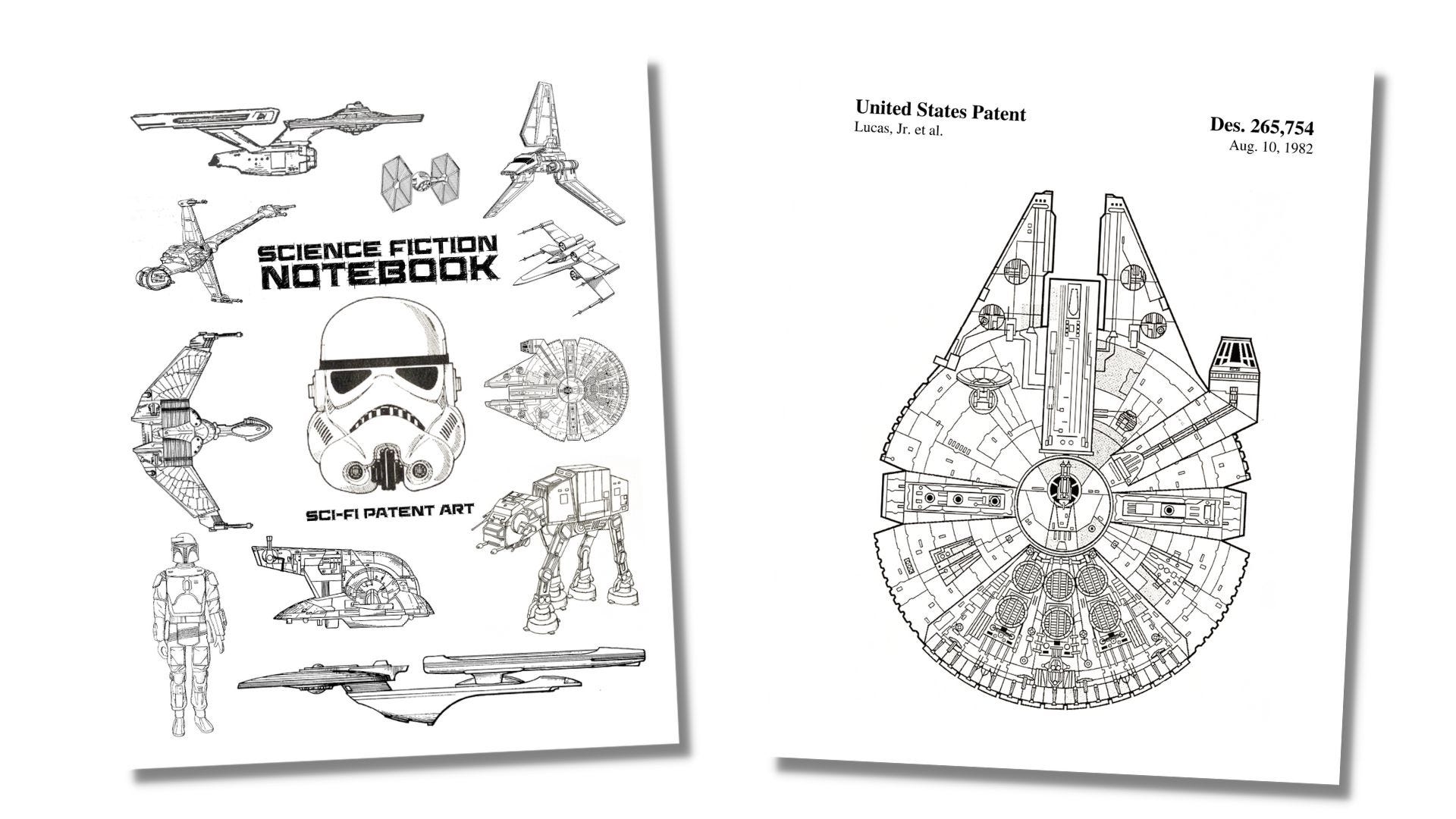
For example, last year I put together a collection of Patent Art (the drawings illustrating an invention on a patent application) for inclusion in an inspiration journal. When patent art is included in a patent application they enter the public domain and can be used freely.6 I decided to include thirty-year-old patent art from Star Wars and Star Trek in a notebook titled, ‘Science Fiction Notebook’ as seen here:
Within moments after submission on Amazon’s KDP website, I got a notice saying the book contained copyrights owned by Disney and that it was being blocked for sale. While I wasn’t relying on fair use I was relying on the fact that George Lucas had put the artwork in the public domain when he included them in his patent applications for the illustrated toys. Despite the fact that my use of these images was legal AND complied with Amazon’s rules the fact that Disney objected was all Amazon needed to hear to censor my book from a platform responsible for the sale of almost 70% of books purchased on the planet earth.
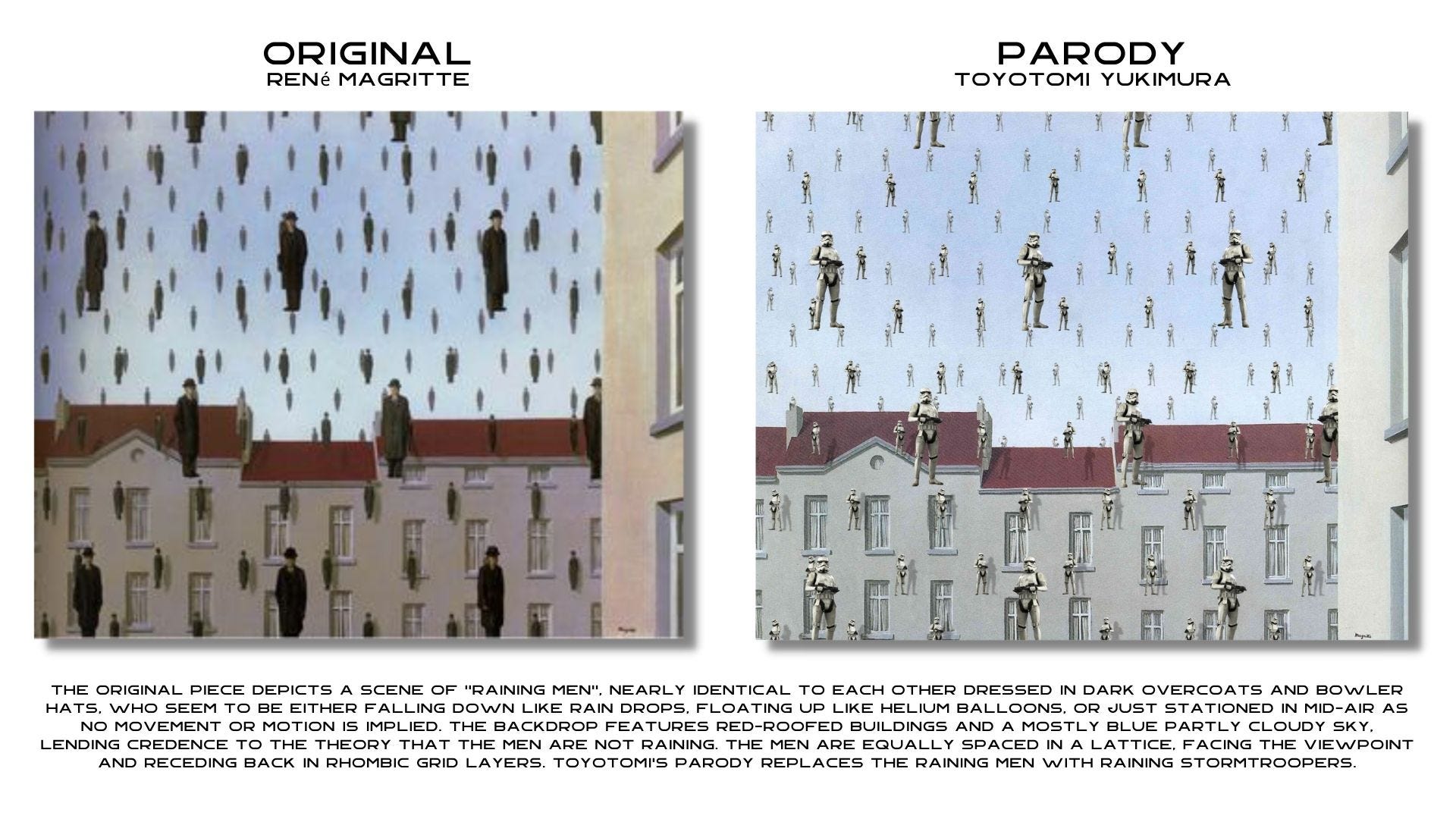
In another example, I created a parody of René Magritte’s Golconda replacing the “raining men” with “raining stormtroopers”. Shortly after uploading my parody to RedBubble (a publicly traded POD platform), I received a notice that BOTH Disney and René Magritte’s estate claimed I was infringing on their copyrights and my work would be removed. Redbubble has an appeal process that includes an exemption for fair use. Parody is ALWAYS considered fair use because, like commentary and criticism, it is using the copyright-protected work to discuss that work. There would be no other way to mock the work without using the work itself in a way that would otherwise be considered infringement. On this basis, I submitted my appeal explaining that my work fits firmly into the parody exception of Section 107 of the Copyright Act. Sadly Redbubble’s appeal process is simply a process - if a copyright holder claims infringement they won’t allow its fair use on their platform - period.
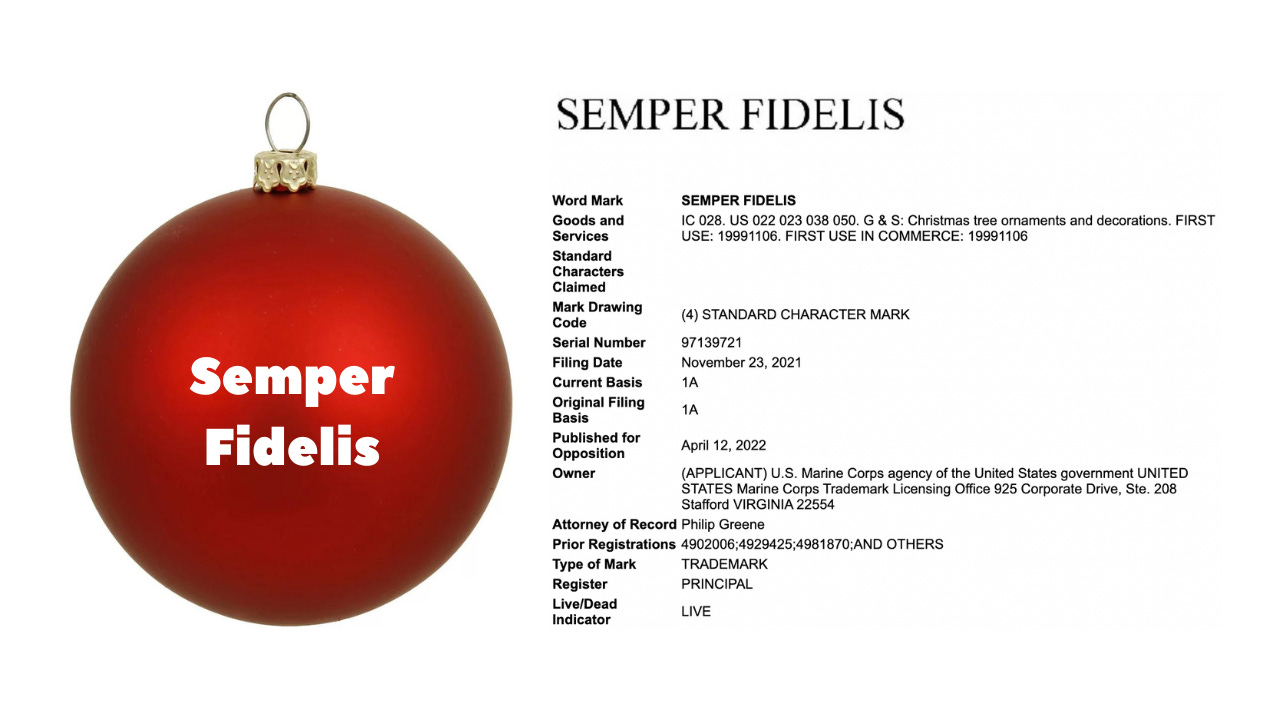
Most recently I included the Latin phrase “Semper Fidelis” (always faithful) on a t-shirt I uploaded on Redbubble and was shocked to learn that the United States Marine Corps claimed they had trademarked the phrase and my shirt would be removed from the platform. Curious I decided to reach out to the USMC and asked them if they really were claiming the exclusive right to the ancient phrase used by the Roman Senate in 72BC.
After a brief search of the USPTO website, it was clear the USMC had been filing trademarks for the phrase on various items including Christmas ornaments, Charms for jewelry, Clocks, Lapel pins, Rings, Watches, Collectible coins, Jewelry hat pins, Bumper stickers, Decals, Metal license plates, and Metal novelty license plates.
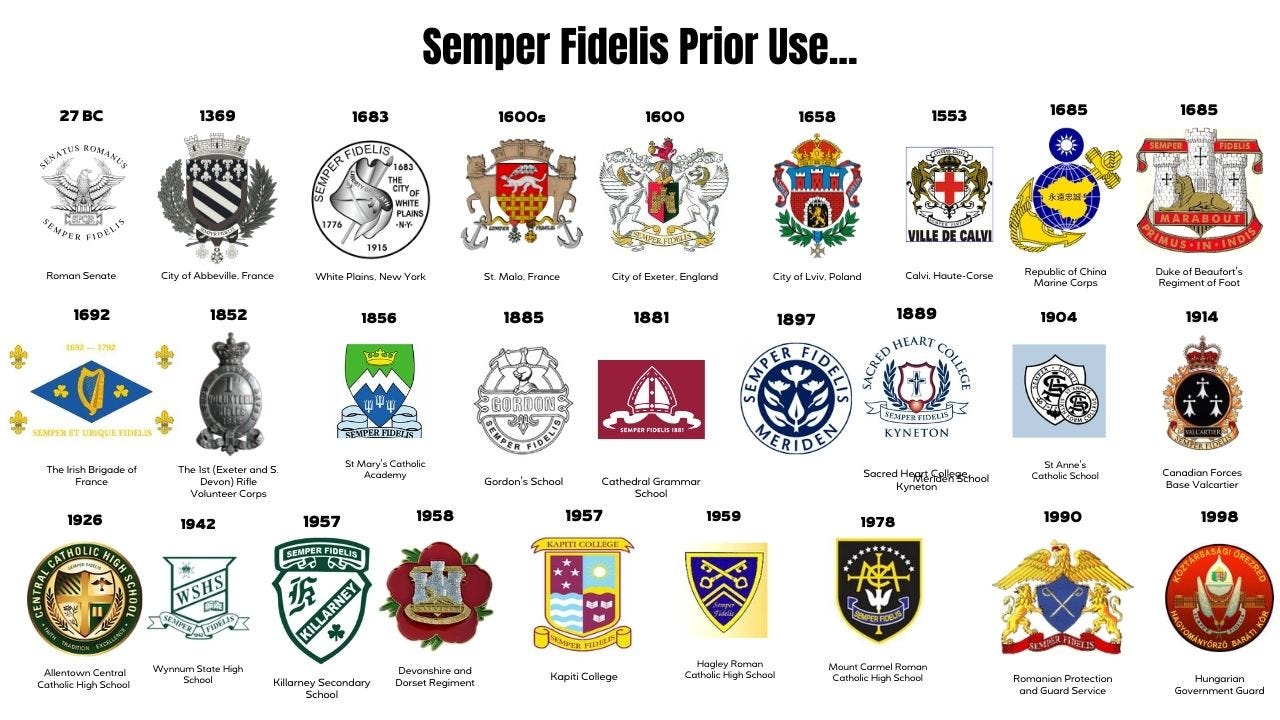
Surprisingly I got an email from Doy Demsick from the USMC who confirmed that YES the Marine Corps was claiming the exclusive use of the Latin phrase. The fact that the USPTO was granting the Corps these marks was unbelievable. I’m a huge fan of the Marines but many organizations were using the Semper Fidelis phrase before the USMC including (just to name a few):
While the USPTO had been granting the USMC trademarks for the use of the phrase on certain items including Christmas ornaments they do not have a ‘blanket’ right to prevent other organizations from using the phrase on other items. In my case, I put the phrase on a t-shirt with a picture of a V-22 Osprey - the USMC simply informed Redbubble they ‘owned’ the term and as a result, Redbubble blocks any product that includes the phrase. After talking to Redbubble they made it clear that even if I obtained declaratory relief from a court proving I had the right to use the mark on a t-shirt they would NOT allow me to sell the product on their platform. I reached out to Amazon and they basically said the same thing.
Over on YouTube, the situation is even direr as creators covering everything from the Johnny Depp v Amber Heard trial to the chord changes of hit songs are getting hit with copyright complaints that cause their videos to be demonetized and removed. For example, Rick Beato a music teacher that runs a YouTube channel that helps people understand how to play popular songs is routinely hit with baseless copyright claims - claims that prevent him from earning money from his videos. I was introduced to him when he broke down the musical elements of Kate Bush’s Running up that Hill. In the video linked below, he explains how broken fair use is on YouTube.
THE ANSWER
It is time for Congress to act. We live in a brave new digital world where Big Tech platforms have supplanted governments in their control over our lives. Congress must ensure that platforms are required to protect legal speech and by extension free expression. Platforms must not be allowed to limit the speech of one political party over another - or one point of view over another. They must not be allowed to limit the fair use of copyright content for criticism, comment, news reporting, parody, teaching, scholarship, and research. Congress needs to shift the balance of power back into the hands of the American people…